
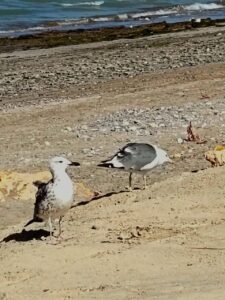

 Spot the difference – seagulls arrive
Lakshmi Kothaneth
November to March is the best time to watch the seagulls in Oman. They are a regular feature at Muttrah Seafront and the long coastline of the Sultanate of Oman, including the wetlands, lagoons, and islands.
Oman sits on the important West Asia-East Africa Flyway and has its own unique wintering sites. They are a major attraction, providing the perfect habitat for hundreds of thousands of migratory birds, including gulls.
Oman has year-round residents, but by November and December, the winter migrants escaping the colder northern climates arrive. Only the bird watchers or ornithologists would know the distinct features of each species of seagull.
Sooty Gull (Ichthyaetus hemprichii) is a resident species and one of the most notable gulls in Oman. They are distinctive with dark/sooty gray upper parts, head, back, and breast, contrasting with white underparts.
They are commonly seen along the coastline, particularly breeding on offshore islands like the Daymaniyat Islands.
Migratory gulls, the winter visitors, are known to migrate from Mongolia, North Russia, Siberia, and the Caspian region.
Key migratory species often observed include Heuglin’s Gull (Larus heuglini), Caspian Gull (Larus cachinnans), Steppe Gull, Lesser Black-backed Gull (Larus fuscus), Brown-headed Gull (Chroicocephalus brunnicephalus) and Common Gull (Larus canus) (also called Mew Gull).
Herring Gulls and Black-headed Gulls are also mentioned as being found at places like Muttrah.
So now is the ideal time to explore the world of seagulls without disturbing them.
Gulls can be found all along Oman’s coast, but some locations are particularly popular for observation.
Muttrah Sea Front is one of the most accessible spots, especially during the winter months, when large flocks of migratory gulls can be seen perched on the Corniche low wall, floating over the water, or resting near the bustling Muttrah fish market, as the seagulls are known to be opportunistic feeders. They feed on fish, crustaceans, and offal.
Daymaniyat Islands Reserve is a key breeding ground for the Sooty Gull and other seabirds. But one needs a permit to visit the islands.
Al Qurm Beach and Lagoon, with its mangroves and mudflats, is an apt place to spot gulls, terns, and various waders.
Located off the east coast, Masirah Island is a major site for seawatching, where you can find various gulls and other seabirds like terns and shearwaters.
The Khor Al Quraym and other coastal wetlands and estuaries along the coast are important feeding and resting areas for gulls and other shorebirds.
The birds in the image shot at Azaiba Beach appear to be Yellow-legged Gulls (Larus michahellis). Adults have a darker grey back and wings compared to some other gull species. Key identification features visible in the image include bright yellow legs, a red ring around the eye, and a yellow bill with a prominent red spot on the lower mandible. This species was previously considered a race of the Herring Gull but is now recognized as its own distinct species, along with the Caspian Gull.
According to the experts, the birds in the image are Lesser black-backed gulls (Larus fuscus). The birds with the checkered plumage are likely juveniles or in their first/second winter, while the one with the solid grey back is an adult.
According to Birdaware.org, there are over 50 different gulls worldwide.
Gulls have also played important roles, such as the California Gull (Larus Californicus) known for its role in helping Mormon settlers with a grasshopper plague in 1848.