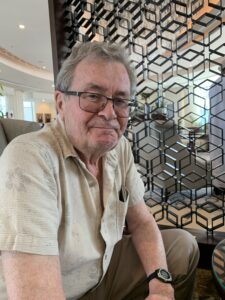
Clive Holes, authorsdProfessor Clive Douglas Cole
A linguist, Professor Clive Douglas Holes, had first come to Oman in 1973. That was when the Seeb airport, as it was known then, had just been inaugurated.
He was working at the British Council in Kuwait and came to Oman to visit his friend after securing a no-objection certificate.
In 1980, 1983 and in 1984, he came back to Oman for short consultancy visits to advise the Foundation Committee of Sultan Qaboos University. And in 1985 Professor Clive was appointed as the Director of the Language Center of Sultan Qaboos University.
Today, he is back in the country as a guest, author and speaker at the 29th Muscat International Book Fair.
At the Book Fair he spoke about the Arabic dialects he observed in the northern parts of Oman. His travels through all the Arab countries where he worked and his own qualification in the Arabic language. He has always pursued two careers: teaching Arabic to English students and English to Arabic students. He was a teacher of the English language for 12 years, and he worked with the British Council in Iraq, Kuwait, Algeria, Thailand, etc.
“Eventually, when he was 34, he decided to pursue the Arabic language.
“I had always been interested in the Arabic language. I had done a degree in Arabic in my 20s, and throughout my career at the British Council, I was sent to Arab countries, so I knew the language pretty well. When I did my PhD, I basically transitioned into Arabic teaching for English kids. It is two sides of the same coin. It is all language teaching. You want to give them usable competency in Arabic. And that is what we did. I remember coming to Bahrain after getting a degree in Arabic from Cambridge. I could not order a cup of coffee in normal Arabic because we were taught the formal language. It was then useless for everyday conversation,” Prof Clive explained.
He said things have changed since then.
In the 80s he travelled around Oman, and that is when he began to explore the dialects of Oman. He has written several books.
“I have always been interested in dialects, as this is what people speak, while classic language is what they write. It became an academic interest because the dialects are hardly written down. We had tongues before we had pens,” noted Prof Clive.
He pointed out that spoken language has its own history but is difficult to track because not many records are kept. We can reconstruct things, and linguists can look into it and see how it has been developed over the centuries.
He recollected how the dialect he had heard being spoken in Dakhiliya was similar to what he had heard being spoken by the farmers in Bahrain.
He explained, “That was a big discovery. I had not suspected it to be true until I came here. I had just overheard, and I happened to speak to someone in Misfat Al Abreen, a well-known village, and in the 80s, it was thriving. I was struck by the fact that the people, like the old man I found working on the falaj, sounded exactly like the farmers I had worked with 20 years before in Bahrain. The similarities were so close that it was impossible for me to believe that they were there by accident. There must have been a reason for that similarity. That was the beginning of my theory about how and why there are similarities between Dakhal and Bahrana dialects. They both farm, grow trees, dates and fruits and so forth. There are similar things in Southern Yemen, which is where, after all, most of the population of Eastern Arabia originates from, as far as we know.”
He is currently working on a new book that will be available on Open Access in the UK so people can read the book free of charge. The book on Oman will appear in Cambridge’s open book series. The hard book would also be available. The book is expected to be around 700 pages, explaining Omani Arabic and its dialects. The title of the book is The Glossary of Northern Omani Dialects.
The author has quotes of people, where it was said and by whom- male or female. The conversations have been recorded in 72 locations.
Is there a danger of losing these dialects? And should we take measures to preserve them?
“Obviously, people’s lives have changed, and they have become more urbanised. And people become more aware of the standardized Arabic. You have got the phenomenon of globalization. On the smaller scale, in the Gulf we have the members of the GCC becoming closer to each other with more travel between countries. All of this means homogenization, where everything boils down to one thing. There is a possibility of losing things, and what we lose are records and words.
I have been coming to Oman since the 70s, and there are some words I know are incomprehensible to many young Omanis. I was just now speaking to a youngster, and I mentioned a couple of words, and she had no idea what they meant. People in the 50s and 60s know what they mean. This shows the pace has changed. So the danger is that this is lost. The clock is ticking, people are getting older, people die, and the people who replace them are not the same in terms of their experience of the world,” he replied.
He added that it is not enough to preserve the planet and the environment.
“There is non-tangible culture, which are things like folk poetry, even the way people used to speak, how they conducted lives. But dialects are soundwaves, and then they are gone. Fortunately, there are ways to record them, and that is to record how they spoke. And once you have the database, you can build on it – this takes money, people and resources and most importantly time. It would be a great thing to have a proper survey of the speech throughout the country,” he concluded.
Lakshmi Kothaneth